 Having Wi-Fi dead zone issues? Both Wi-Fi extenders and mesh networks promise to improve and extend your Wi-Fi signal, but they achieve this through different means. Plus, if you don’t purchase the appropriate system, you may find that the investment wasn’t worth it. Here’s what to know.
What Is a Range Extender?
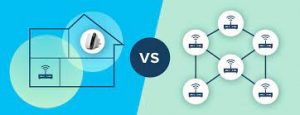
A range extender is usually a box that plugs directly into an outlet “wall wart”-style. It may or may not have external antennas, and as the name implies, it extends the range of your Wi-Fi network.
If, for example, your Wi-Fi network is strong in your home’s living room, bedrooms, and kitchen, but it doesn’t reach the den, then a strategically placed range extender may help get you the coverage you need. Range extenders were a popular option for improving home networks prior to the arrival of mesh systems. When shopping for an extender, however, confusion usually arises because you can also run across devices called Wi-Fi repeaters, extenders, or boosters.
Extenders typically have a different network name (SSID) from the main home network, such as “Home Wi-Fi” and “Home Wi-Fi Ext.” Some devices do allow you to use the same name and password for both the extender and the main network, but that usually isn’t a good idea. The problem is that your wireless device may keep trying to remain connected to the weaker signal, resulting in frustration for you.
If you just have both networks saved under different names, your phones and tablets should just connect to the stronger signal. And if you are using the wireless signal for a television or console, then it’s wise to only give those devices the extender’s Wi-Fi credentials to prevent connection attempts to the weaker signal. While extenders can help a great deal, the problem is that the Wi-Fi signal degrades the further away you get from the source (your ISP router or modem). So, if you use two extenders to hit the basement, for example, the speed and strength of your Wi-Fi will often be noticeably slower.
What Is Mesh Wi-Fi?
When extenders aren’t up to the job, mesh networking becomes a very attractive solution. Mesh networks are often referred to as systems that “blanket” your home in Wi-Fi. A mesh system is made up of a source router and additional “satellite nodes” that can be placed around the home. The number of nodes you need depends on the size of your home and the coverage the particular system covers. Some manufacturers have systems, like the Netgear Orbi 970, that cover up to 10,000 square feet with a single router and node, while others need three or more devices to cover an area that size.
Once they’re installed, mesh devices connect to each other to provide a strong Wi-Fi signal across your entire home under a single network name. As you move through the home, your mobile devices simply connect to the device with the best signal for that part of the house. Like extenders, mesh systems also repeat that original signal coming from the source of your ISP-provided modem or gateway. However, the difference is that these routers are far smarter and more powerful than a regular extender. If you get a tri-band mesh system, for example, the system typically dedicates one of its bands for data backhaul. That simply means that the routers use one band exclusively for communicating with each other to vastly improve performance over what even a tri-band range extender could do. The other two bands, meanwhile, are for your devices to use. Dual-band mesh systems will also use backhaul, but they share that bandwidth with other devices on your network, thus the performance isn’t as high as a tri-band system’s.
Mesh systems can also come with a ton of extra features depending on the system you purchase. They can integrate with smart home devices, act as a smart home hub, or come with built-in speakers that double as smart speakers.
Remember: More Coverage May Not Be What You Need
We’ve covered the technical differences between mesh networks and Wi-Fi extenders, but before we recommend one over the other, you should consider your actual wireless needs. Does your Wi-Fi seem sluggish or spotty across your home? Factors like congestion from neighbors, low-speed internet plans, and poor router positioning could easily be at play and won’t be fixed by an extender.
Replacing your standalone router with a mesh system won’t either—necessarily. If your router is old enough, upgrading to a mesh network that uses the Wi-Fi 6 standard or newer can bring improvements that go beyond just coverage. Especially with the arrival of Wi-Fi 6E and Wi-Fi 7, the latest wireless specifications do a lot to manage congestion and improve your signal in general. If you are indeed experiencing dead zones (areas of your home where your Wi-Fi signal consistently disappears), and you’ve already tried repositioning your router, then we can confidently say either an extender or a mesh network upgrade will likely serve you well.
Mesh vs. Extender: Which One Is Right for You?
Deciding between getting a mesh system versus an extender comes down to a few issues. First, a mesh system is going to be more expensive. Even if you just need a router and satellite, that’s going to run you in the hundreds of dollars compared to a less expensive extender that can be picked up for $50 to $100, such as TP-Link’s RE450. If you just have one room that’s a dead spot in the house, then a single extender might be the better choice. The minute it starts to look like you’ll need multiple extenders to make it work, however, a mesh system is often the better option.
There are tons of mesh systems out there for every budget. Ideally, you’d get a tri-band system with a dedicated band for backhaul. But if your budget doesn’t fit that, there are many dual-band systems that are still very good.
For more information on solutions for running your businesses’ technology more efficiently, visit our website or contact Megan Meisner at mmeisner@launchpadonline.com or 813 448-7100 x210.
This was originally posted by HowtoGeek.